
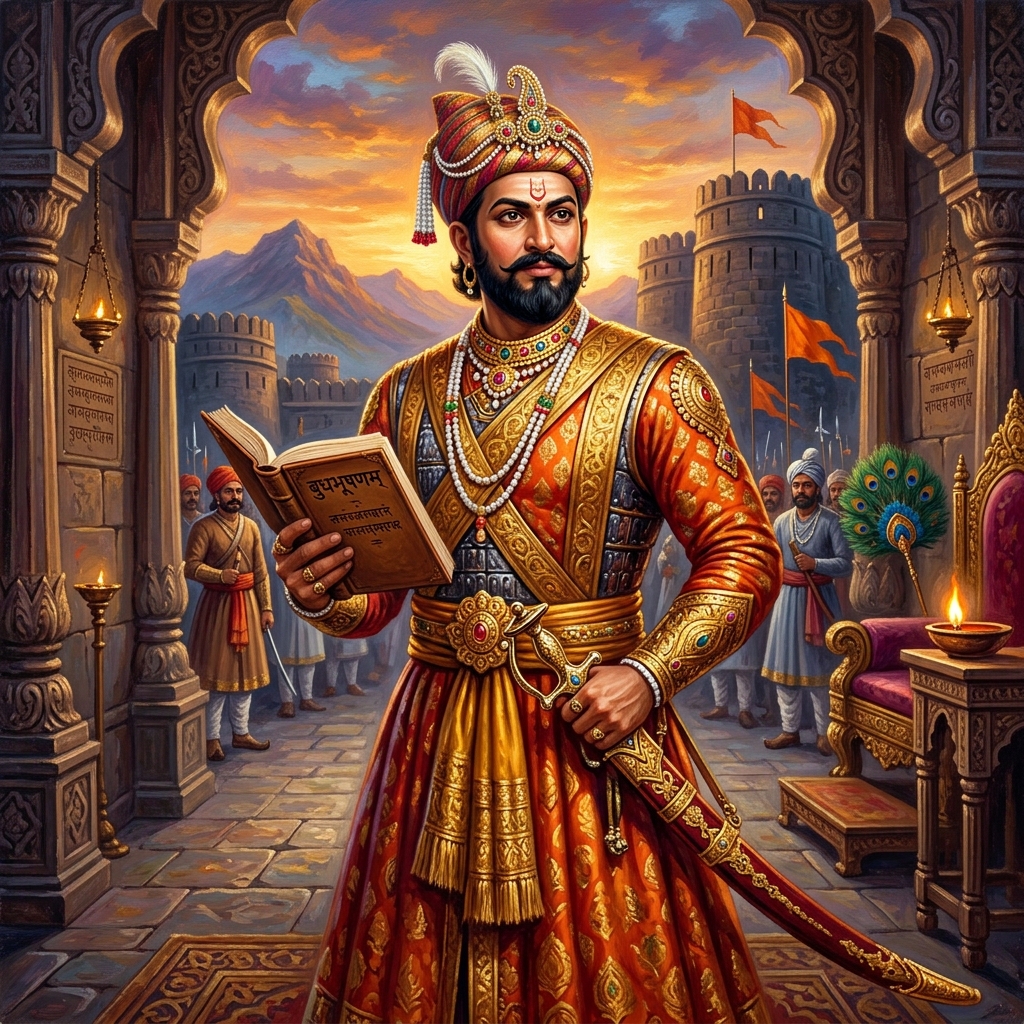
Chhatrapati Sambhaji Maharaj (1657-1689), the eldest son of the great Chhatrapati Shivaji Maharaj, is remembered as one of the most fearless warriors and steadfast defenders of the Maratha Empire. However, beyond his unmatched courage and leadership, there was another extraordinary side to him — that of a brilliant scholar and polyglot who mastered several languages at a remarkably young age.
A Scholar Since Childhood
From the time he was a child, Sambhaji Maharaj displayed exceptional intelligence and curiosity. His education began under the finest scholars of his time, who trained him in grammar, philosophy, politics, and classical literature. Unlike most princes who focused solely on warfare, Sambhaji’s interests extended deep into the world of books and languages.
It is said that by the age of nine, he had already mastered nine languages, and as he grew older, this number increased to around fifteen or sixteen. Whether it was the sacred Sanskrit of scriptures or the refined Persian of royal courts, Sambhaji Maharaj embraced every language with equal enthusiasm.
Languages Known
Though accounts vary, most historians agree that Sambhaji Maharaj had a command over at least eight to ten major languages:
His Literary Works
Sambhaji Maharaj wasn’t just a reader — he was a prolific writer and thinker. His most renowned Sanskrit work, “Budhbhushanam”, reflects his profound understanding of politics, ethics, and the duties of kingship. He also wrote other texts and verses in Hindi and Braj, displaying both poetic skill and philosophical depth.
Through his writings, he expressed thoughts on governance, religion, and moral values — qualities that reveal his vision of a wise and righteous ruler.
Sambhaji Maharaj’s linguistic and literary abilities broke stereotypes of kings being only warriors — he proved that true strength lies in both wisdom and valor.
Why He Learned So Many Languages
- Deep Cultural Understanding As a ruler, he believed that understanding multiple languages meant understanding multiple cultures. It helped him connect with scholars, priests, diplomats, and subjects across regions.
- Diplomacy and Administration The Maratha Empire had political dealings with the Mughals, Adil Shahi rulers, and European traders. Knowing their languages gave Sambhaji Maharaj a unique advantage in negotiations and military intelligence.
- Religious and Philosophical Study Sanskrit connected him with Vedic and Dharmic wisdom, while Persian and Arabic opened doors to Islamic literature and foreign thought. His multilingualism expanded his worldview beyond regional boundaries.
- Literature and Art He was deeply interested in poetry, drama, and philosophy — fields that require linguistic precision. His mastery of many tongues made him an artist in expression as well as a strategist in war.
The Intellectual Warrior
Sambhaji Maharaj’s intellectual brilliance perfectly complemented his military genius. While he fought fiercely to protect the Maratha Empire, his knowledge of languages helped him understand the minds of his enemies and the hearts of his people.
Legacy of a Polyglot King
Chhatrapati Sambhaji Maharaj remains a symbol of courage, intellect, and patriotism. His life teaches us that knowledge is the greatest weapon a ruler — or any individual — can possess. His mastery over multiple languages wasn’t just an academic achievement; it was a reflection of his curiosity, adaptability, and deep respect for every form of wisdom.
In an age where most rulers communicated through interpreters, Sambhaji Maharaj spoke directly — in the language of diplomacy, devotion, and destiny.
Conclusion
Chhatrapati Sambhaji Maharaj’s story is not only that of a brave king but also of a scholar who bridged cultures through the power of language. His polyglot nature stands as a reminder that intellect and strength are not opposites — they are two sides of true greatness.
He was, indeed, a warrior with the sword of knowledge — a true Polyglot King of India.